CYC Chainring Guide
This guide will help you understand how to choose the right chainring for your CYC motor-equipped bike, what chain line is, and why it matters. We’ll also explain the differences between large and small chainrings, their benefits, and how to ensure optimal fitment.
What is a Chainring and Why Does It Matter?
The chainring is the gear attached to your cranks (pedal area). It influences your bike’s gearing and overall ride experience. When fitting a CYC motor, selecting the right chainring ensures smooth power transfer, efficient riding, and reduces wear and tear.
CYC chainrings are all narrow-wide, which means their tooth profile alternates to grip the chain better and prevent it from falling off—especially important when using a motor for assistance.
Understanding Chain Line and Its Importance
The chain line is the straight path the chain takes from the front chainring to the rear sprocket. Think of it as a highway for your chain. A proper chain line ensures:
- Smooth shifting
- Reduced chain wear
- Less noise
- Lower risk of the chain dropping
Why is chain line important? If the chain line is crooked, it puts stress on your chain and gears, and can cause the chain to skip or fall off, especially under motor power.
How to Check Your Chain Line
Signs of a misaligned chain line:
- Noise or clicking when shifting
- Chain falling off during riding
- Chain skipping or jumping gears
- Excessive wear on chain or sprockets
Adjusting chain line depends on your bottom bracket type and motor mounting position. For CYC motors, we provide recommended chain line values depending on your setup.
Chainring Options for CYC Motors
Choosing the right chainring depends on your riding style, terrain, and desired speed:
Small Chainring | Teeth | Benefits | Ideal for |
Photon Gen 2/Pro | 32T, 34T, 36T, 38T, 40T, 42T | Low gear ratio | Hilly terrains, steep climbs |
X1 Pro Gen 4 | 32T, 38T | Maximize torque, low effort | Steep, challenging terrains |
Large Chainring | Teeth | Benefits | Ideal for |
Photon Gen 2/Pro | 50T | High gear ratio | Open roads, flat terrains |
X1 Pro Gen 4 | 40T (equivalent to 42T bike chainring) | Faster cruising, better momentum | Long-distance rides |
Chainring Sizing & Compatibility
CYC motor kits come with different stock chainrings, but you can upgrade or replace them with any standard 104 BCD (Bolt Circle Diameter) chainring for the X1 Pro Gen 4. Note that the Photon uses a proprietary spline interface for the chainring to motor spider connection, meaning standard 104 BCD chainrings cannot be directly mounted to the Photon motor.
X1 Pro Gen 4 Configuration
Configuration | Stock Chainring | Equivalent Bike Chainring Size | Diameter |
11/53 | 32T | 32T bike chainring | ~219 mm |
11/63 | 38T | 38T bike chainring | ~238 mm |
11/72 | 40T | 42T bike chainring | ~242 mm |
Note: Larger chainrings give higher top speeds but may reduce ground clearance. Smaller rings are better for hill climbing.
Chain Line Adjustment for CYC Motors
Why adjust the chain line? Proper chain line ensures your motor runs smoothly, gears shift cleanly, and the chain stays aligned.
Here are the official chain line values based on your bottom bracket type, extracted from the CYC user manuals:
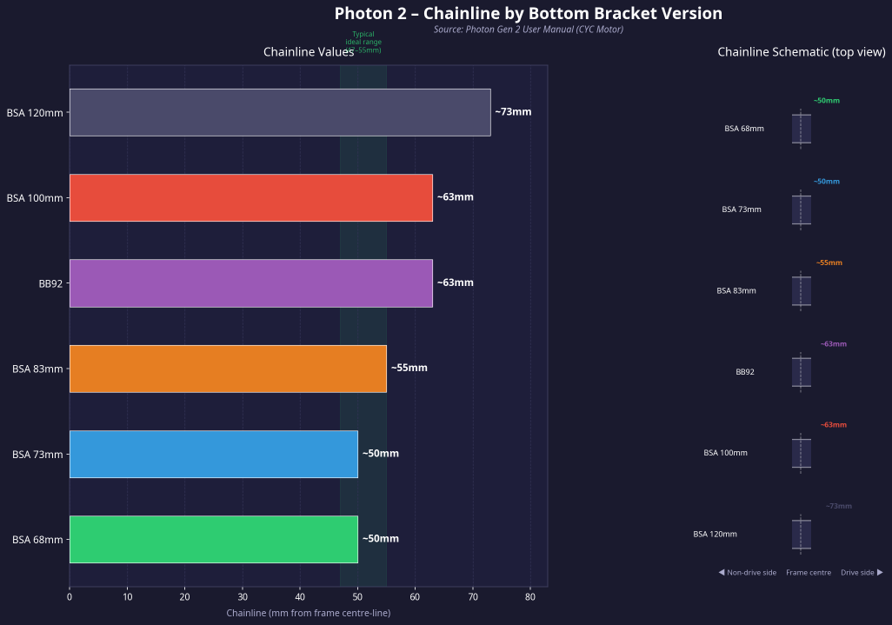
Photon 2/Pro (Gen 2) Official Chainline Values
Bottom Bracket Type | Chainline | Spacer on Left | Spacer on Right |
BSA 68mm | ~50 mm | 5+7 mm | 3 mm |
BSA 73mm | ~50 mm | 3+7 mm | None |
BSA 83mm | ~55 mm | None | None |
BB92 | ~63 mm | 3+3 mm | None |
BSA 100mm | ~63 mm | None | None |
BSA 120mm | ~73 mm | None | None |
Important Note: Photon 2/Pro with 32T/34T Chainring Option
If you are running the 32T/34T chainring option on the Photon 2, please be aware that the 32T/34T sprocket assembly is offset by 9.5 mm outward (toward the drive side) compared to the other chainring sizes. This means the effective chainline will be 9.5 mm greater than the standard values listed in the table above.
The adjusted chainline values for the Photon 2 with the 32T/34T option are shown below. Use these figures — not the standard table — when checking fitment or diagnosing chain alignment issues on a 32T/34T setup.
Photon 2/Pro —32T/34T Chainring Option (9.5 mm offset applied):
Bottom Bracket Type | Standard Chainline | 32T/34T Chainline (+9.5 mm offset) |
BSA 68mm | ~50 mm | ~59.5 mm |
BSA 73mm | ~50 mm | ~59.5 mm |
BSA 83mm | ~55 mm | ~64.5 mm |
BB92 | ~63 mm | ~72.5 mm |
BSA 100mm | ~63 mm | ~72.5 mm |
BSA 120mm | ~73 mm | ~82.5 mm |
What this means for you: A higher chainline on the 34T option may result in a slight cross-chain angle when using the smallest rear sprockets. For most riding this is acceptable, but if you notice chain noise or wear on the smallest cogs, consider shifting to a mid-range sprocket to keep the chain running straighter.
X1 Pro Gen 4 Official Chainline Values
Bottom Bracket Type | Chainline | Spacer on Left | Spacer on Right |
BSA 68mm | 51 mm | 5+7 mm | 3mm |
BSA 73mm | 50.5 mm | 3+7 mm | None |
BSA 83mm | 55.5 mm | None | None |
BB92 | 55.8 mm | 3+3 mm | None |
BSA 100mm | 63 mm | None | None |
BSA 120mm | 74 mm | None | None |
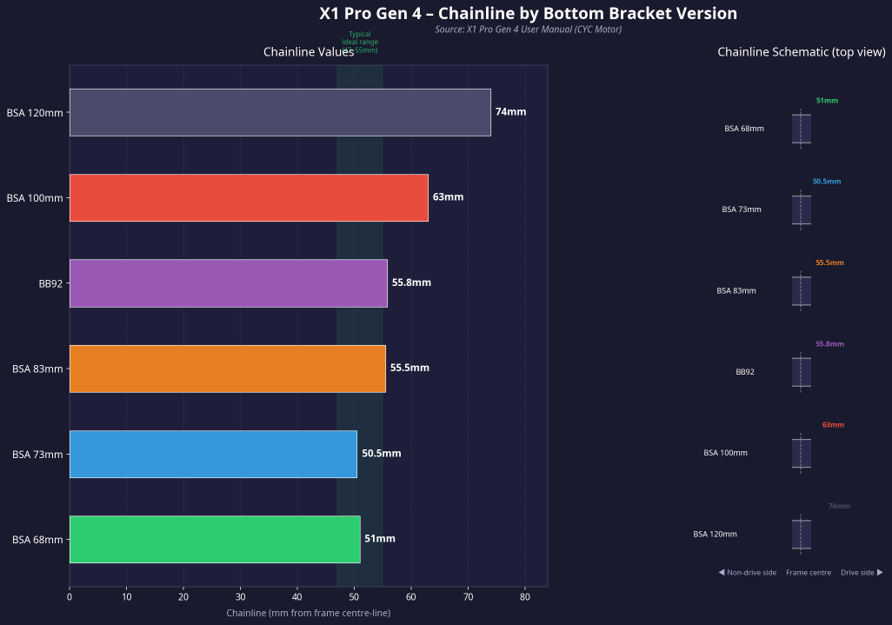
Adjusting chain line may involve swapping spacers or changing the chainring position. Please note that the spacers can be adjusted to accommodate different chainlines as needed for your specific frame.
Swapping Out the Chainring
When replacing your chainring:
For Photon 2/Pro: You need the full Photon 2/Pro sprocket set (not just the chainring alone) if changing sizes.
The set includes:
- Photon Chainring Adapter
- Photon Sprocket
- Aluminum/Carbon Chain Guard
This ensures compatibility and proper fitment. The newer 34T version features mechanical interlocking (spline) between the chainring and the spider, enhancing reliability under vibration, and the chainring is now replaceable on its own.
For X1 Pro Gen 4: You can replace the outer chainring with any 104BCD standard bicycle chainring. If changing the 219H motor chain sprocket size, you must also purchase a matching 219H Golden Motor chain.
Benefits of Large vs Small Chainrings
Large Chainrings | Pros | Cons |
Higher top speed | Better efficiency on flat terrain | Less torque for hills, more effort needed to climb |
Longer gear ratios | Faster cruising | Reduced ground clearance |
Small Chainrings | Pros | Cons |
Easier hill climbing | Better torque, less fatigue | Lower top speed, more pedaling effort on flat terrain |
Final Tips
- Match your chainring size with your riding style and terrain.
- Ensure proper chain line for smooth operation—consult your motor setup’s recommended chain line values.
- When upgrading chainrings, select a size compatible with your motor’s gear ratio and clearance needs.
- Regularly check chain alignment and wear.
- If you need help choosing the right chainring or adjusting your chain line, contact our support team or visit your local bike shop for assistance.
Chainring Fitment Templates (Printouts)
To help ensure proper clearance and fitment before installing your chainring, CYC provides downloadable chainring printout templates.
These templates allow you to physically simulate chainring size and position on your frame—helping you confirm compatibility with chainstay clearance, frame geometry, and motor positioning before committing to installation.
Accessing the Templates
All available chainring printouts can be found on the CYC Downloads page:
👉 https://www.cycmotor.com/downloads
How to Use the Templates
- Download the correct chainring printout for your motor and desired size.
- Print on A4 paper at 100% scale (1:1) — ensure “Original Size” is selected and do not use “fit to page”.
- Cut out the template along the outer edge.
- Align it with your crank and bottom bracket area to simulate chainring placement.
- Check for clearance and interference, especially around:
- Chainstays
- Frame welds or suspension pivots
- Motor housing and bash guards
Important Notes
- Templates are reference tools only and do not replace final installation checks.
- Always confirm real-world clearance once components are installed.
- For Photon setups, ensure you’re using the correct printout for the complete sprocket assembly, not just the chainring itself.
- Example: The Photon Gen 2 36T template is provided at true 1:1 scale and designed for A4 printing to maintain dimensional accuracy.